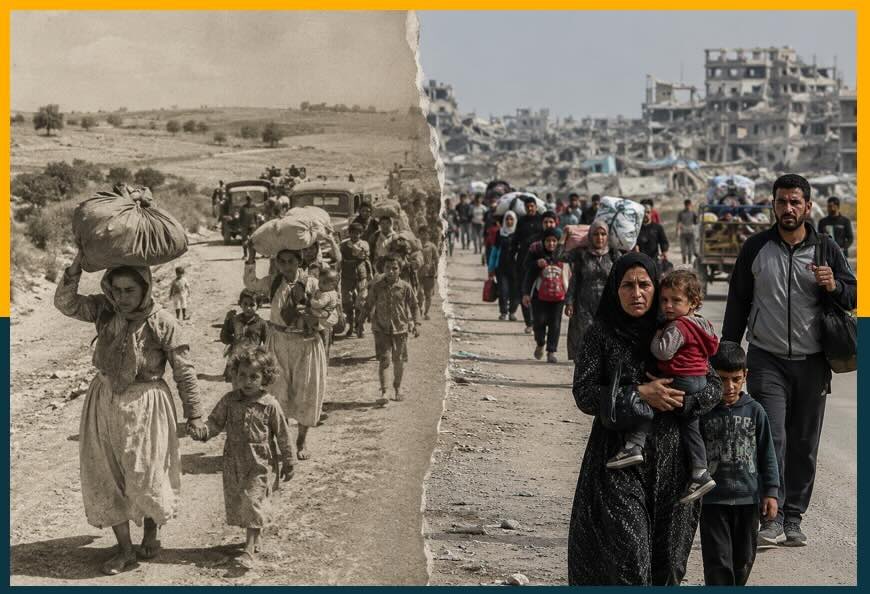
On the 78th anniversary of the Palestinian Nakba, the catastrophe no longer appears as a distant historical event, but as an ongoing reality lived daily by millions of Palestinians under war, displacement, and forced exile, particularly in Gaza and the occupied West Bank.
In 1948, more than 750,000 Palestinians were forcibly displaced from their towns and villages during the establishment of Israel, while hundreds of Palestinian communities were destroyed. The result was the creation of one of the world’s largest and longest standing refugee populations, with the effects of the Nakba continuing today through occupation, settlement expansion, blockade, and repeated displacement.
According to figures released by the Palestinian Central Bureau of Statistics, the number of Palestinians worldwide has reached approximately 15.5 million people, nearly half of whom live outside their homeland. Around 8.1 million Palestinians live in the diaspora, including 6.8 million across Arab countries, while approximately 7.4 million remain in historic Palestine.
The report states that by the end of 2025, the Palestinian population in the State of Palestine had reached around 5.6 million people, including 3.43 million in the occupied West Bank and 2.13 million in the Gaza Strip, which is currently enduring one of the worst humanitarian catastrophes in modern history.
Since 7 October 2023, nearly two million Palestinians in Gaza have been forcibly displaced after being driven from their homes under bombardment. Many now live in tents and overcrowded shelters lacking even the most basic necessities, including food, clean water, and healthcare.
The Palestinian statistics authority also reported damage to more than 198,000 buildings across Gaza, including over 102,000 completely destroyed structures. The destruction has devastated infrastructure, hospitals, schools, water systems, and electricity networks, while international organisations increasingly warn that Gaza is becoming “uninhabitable”.
In the occupied West Bank, settlement expansion continues at an accelerating pace. By the end of 2025, there were 645 Israeli settlement sites and military bases, including 151 settlements and 350 settlement outposts, alongside industrial, service, and military facilities. This expansion has coincided with intensified military raids, arrests, and forced displacement of Palestinians.
Despite the passing of 78 years since the Nakba, Palestinians continue to hold firmly to their right to return and to live in freedom and dignity. For many, the Nakba did not end in 1948. It continues every day in different forms, through displacement, siege, loss, and the ongoing struggle for safety and survival.