How did they study? When did they sit their exams? And how did they succeed?
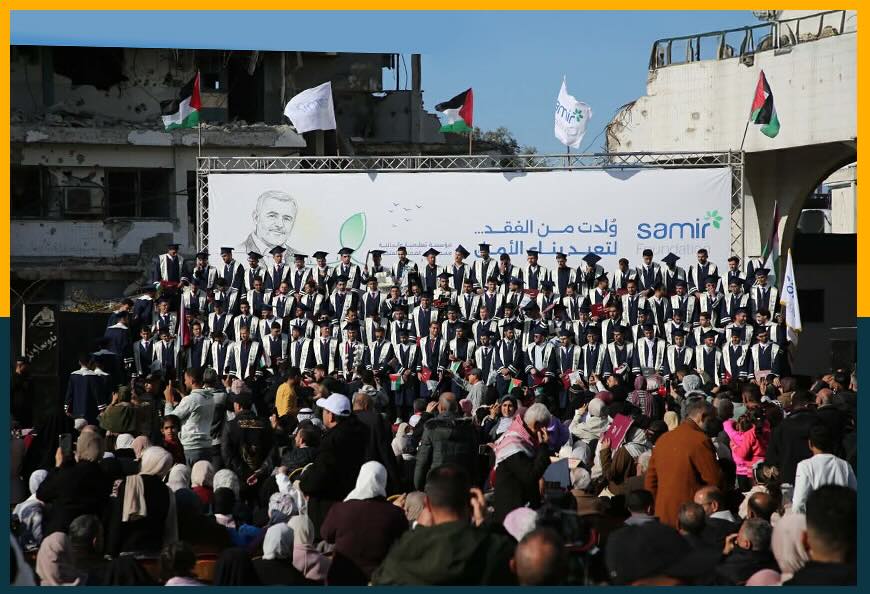
These questions echo with genuine disbelief when faced with an extraordinary scene unfolding in Gaza today. More than 300 male and female medical graduates from Al Azhar University and the Islamic University are being honoured in the courtyards of Al Shifa Hospital, a place that has, over recent months, become a symbol of immense suffering and remarkable survival. This is a graduation unlike any other. Those standing here did not follow a conventional path to qualification. They carved their way through war and devastation, proving that hope in Gaza is an act of resistance that refuses to break.
The Gaza in which these students lived was the site of an unprecedented assault. Available figures indicate that more than 35,000 Palestinians have been killed and over 80,000 injured. Around 70 percent of residential buildings have been destroyed or damaged. More than 25 hospitals and healthcare facilities have been forced out of service. Over 90 percent of university and educational buildings have been partially or completely destroyed. In this reality, thousands of students lost their places of study. Most were forcibly displaced. Daily life became a relentless struggle for survival.
Yet medical students did not stop learning. They studied under conditions that were almost impossible. There was no regular electricity, no reliable internet, and no lecture halls. They relied on candlelight, alternative phone charging sources, and whatever printed books or digital files they could salvage. Many revised their lectures between airstrikes or after long hours of voluntary work in hospitals and field medical centres. Academic estimates suggest that more than 60 percent of clinical year students were directly involved in providing first aid or supporting medical teams during the assault.
Examinations were not held in normal academic settings. They were postponed repeatedly, then reorganised during brief ceasefires or periods of relative calm. Exams took place in alternative locations, some inside medical facilities or temporary halls, with minimal resources and overwhelming psychological pressure. Despite this, the pass rate exceeded 85 percent among candidates. This stands as a clear indication of discipline, commitment, and resilience under extreme conditions.
The success of these graduates is not merely academic. It is a moral and human victory. They studied medicine while living its harshest realities. Every day they witnessed shortages of medication, overcrowded emergency rooms, missing equipment, and the loss of patients. This experience transformed theoretical knowledge into lived practice and embedded a deep understanding that medicine in Gaza is not simply a profession, but a national and humanitarian responsibility.
Today, more than 300 new doctors graduate from the heart of suffering, at a time when health reports confirm that Gaza urgently needs thousands of medical professionals to compensate for the severe shortages caused by the war. These graduates are not just names on a list. They are 300 stories of steadfastness and 300 living testimonies that this land, despite its wounds, continues to produce those who heal it.
In Gaza, universities may be destroyed and dreams may be besieged, but determination remains stronger than war. These newly qualified doctors stand as living proof that knowledge cannot be bombed, and that hope, no matter how dark the moment, remains a distinctly Gazan force that refuses to die.