
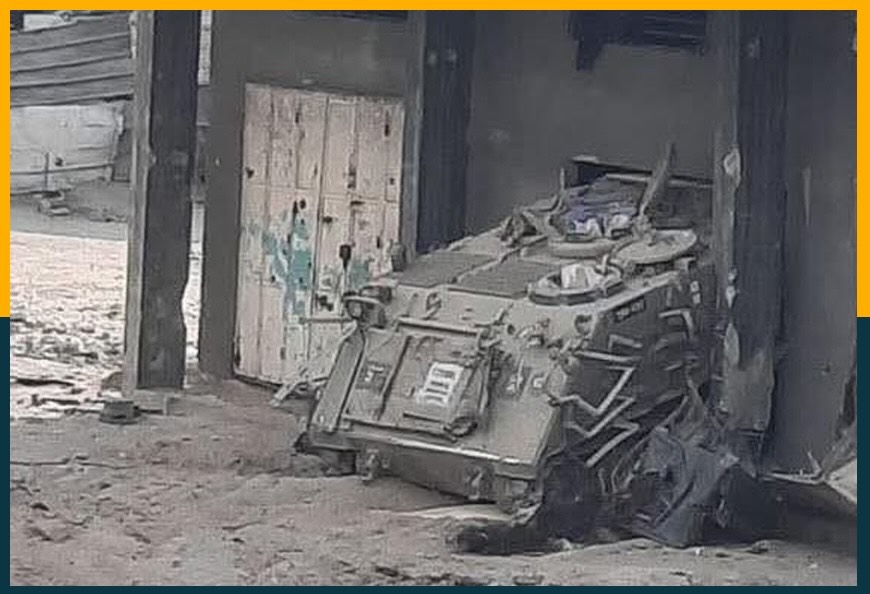
Since the outbreak of the war on Gaza, Israel has routinely introduced advanced tools of warfare into the battlefield. This time, however, a new and deadly chapter has emerged: the robot has surfaced as one of the most dangerous methods of combat, adding another bloody page to the tragedy of civilians.
Israel has adopted this new tactic by converting decommissioned armoured personnel carriers, often M113 models that have been retired from service, into remotely operated bombs. These vehicles are packed with between three and five tonnes of highly explosive material, pushed into the heart of residential districts, and detonated. The resulting blast produces a destructive radius estimated at between 100 and 300 square metres, flattening everything within range.
This method of warfare is designed to exhaust the civilian population, forcing families to flee under the weight of relentless fear and destruction. It allows Israel to limit its own battlefield casualties in direct combat while imposing collective punishment on civilians by systematically demolishing their homes.
The catastrophe is that the robot is not merely a killing device, it is a repeat killer. Its impact goes far beyond the initial detonation, triggering cascading building collapses that multiply the number of victims and deepen the scale of devastation.
The “explosive robot” was first documented in Jabalia in May 2024. Since then, the Israeli army has employed it extensively across Gaza. In the Zeitoun neighbourhood alone, more than 500 homes were destroyed from the beginning of August 2025, the result of robot detonations as well as missile strikes.
Human rights organisations warn that deploying such technology in densely populated civilian areas raises grave concerns about proportionality and distinction, which are two of the most fundamental principles of international humanitarian law.
Field reports have documented booby-trapped vehicles being used to level entire districts in what has been described as a “weapon that kills from a distance.”
The robot is not simply a remote-controlled machine, it is the embodiment of Israel’s policy of continuous death in Gaza, a sleepless killer that leaves behind shattered neighbourhoods and survivors haunted by the terror of the next blast.
Even more troubling, it forms part of a systematic strategy to manage the war by expanding invasion corridors and imposing mass terror on civilians. In the absence of international accountability, one question remains: how many more lives will this technology claim before the bloodshed ends?