In every conflict, words and images often prove more powerful than bullets. For those intent on concealing the truth, the eyes that bear witness become targets. The ongoing genocidal war on Gaza has not only destroyed homes, schools and hospitals, it has also directed its fire at journalists in a calculated attempt to silence the truth and obscure the reality from the world.
During this devastating campaign, Israel has targeted close to 238 journalists, an unprecedented toll that has made Gaza the most dangerous place on earth for media work. These figures reveal more than a humanitarian tragedy; they expose a deliberate strategy to eliminate the Palestinian voice and prevent the documentation of violations. Israel knows that when the camera falls silent, testimony disappears. Killing a journalist is not merely ending a life, it is erasing an entire narrative.
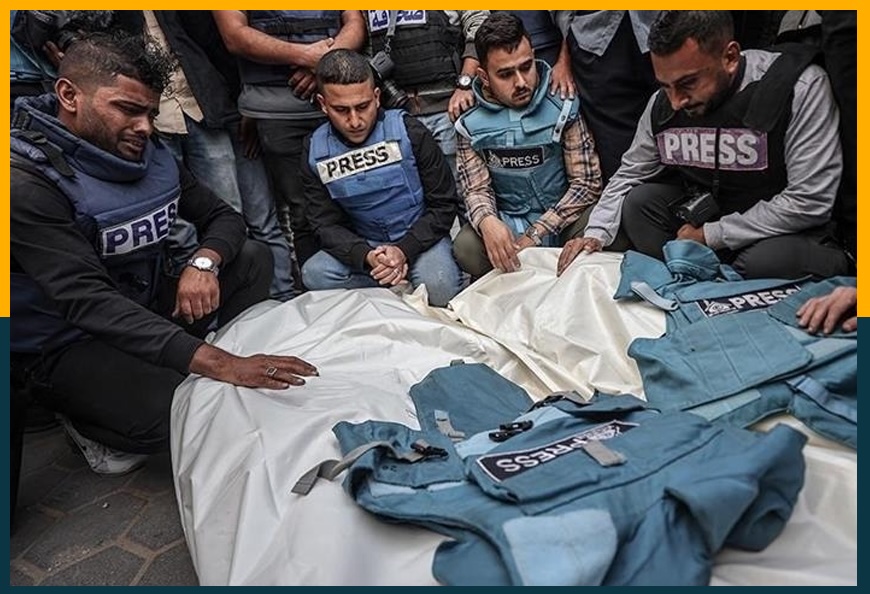
The targeting of journalists in Gaza has shifted from isolated incidents to a systematic pattern striking at the heart of the press corps. The most recent attack came just days ago, when Israeli warplanes bombed an Al Jazeera tent near Al-Shifa Hospital, killing reporters Anas Al-Sharif and Mohammed Qreiqa, alongside cameraman Ibrahim Thaher, videographer Moamen Alouah, and assistant cameraman Mohammed Noufal.
This deliberate assault raises serious questions about an intentional effort to stifle field reporting and muzzle free voices. It follows a long series of killings and attacks on journalists since the start of this genocidal war, a blatant violation of international humanitarian law and the Geneva Conventions, which guarantee the protection of media workers.
Past crimes against Gaza’s journalists further illustrate the pattern. On 24 March, Israel assassinated journalist Hussam Shabat in a direct strike in northern Gaza. In April, photojournalist Fatima Hassouna was killed when her home was bombed. On 31 July 2024, Al Jazeera’s Ismail Al-Ghoul and cameraman Rami Al-Rifai were also killed.
According to Reporters Without Borders (RSF), more than 237 journalists have been targeted since the genocidal war began, a record high in modern armed conflicts. The Committee to Protect Journalists (CPJ) documented the deaths of 186 journalists and media workers by the end of July 2025, the vast majority Palestinian, in addition to over 130 cases of arrest, injury or assault. The Watson Institute has described this war on Gaza as the deadliest for journalists in modern history, surpassing Vietnam, Yugoslavia and Afghanistan.
The implications of such relentless targeting are clear. It is designed to erase facts, deny the world the Palestinian narrative and create a climate of fear that deters on-the-ground coverage. This approach carries the wider danger of enabling ethnic cleansing by removing witnesses and silencing those who document atrocities. It constitutes a grave breach of international law, with Article 79 of the Additional Protocol to the Geneva Conventions explicitly protecting journalists in conflict zones.
The UN Secretary-General has called for independent investigations, condemning the killing of journalists as a serious violation of international law. Global organisations including Amnesty International and RSF have demanded accountability and an immediate end to the targeting of media workers. Political leaders in Britain, France and beyond have voiced deep concern and urged guarantees for journalists’ safety.
Ultimately, the targeting of journalists in Gaza is no longer an exception; it has become an entrenched feature of this genocidal war. It endangers press freedom, denies the world the right to know, and, if left unchecked, will render journalism in conflict zones a suicide mission, leaving war crimes and acts of ethnic cleansing without witnesses or evidence. Protecting journalists is not merely a professional demand, it is a moral, legal and human obligation the international community must urgently uphold.